Solid-State Lithium-ion Batteries Commercialisation (2025)
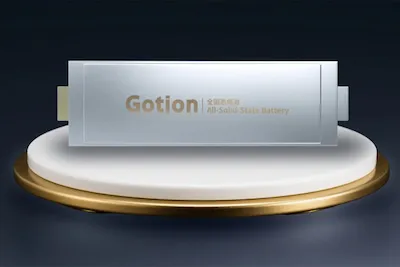
Solid-state lithium-ion batteries are expected to become the dominant technology for next-generation batteries with global enterprises expanding their presence.
EV-Type LIB manufacturers that have developed solid-state lithium-ion batteries include Toyota, Samsung SDI Japan, Idemitsu Kosan, Nippon Fine Porcelain, Corning, and Celgard.
In the field of 3C lithium-ion batteries (computers, communication and consumer), major solid-state batteries manufacturers include Apple and Samsung SDI.
Due to the earlier planning and layout of solid-state battery industrialisation, Japan is currently in a leading position in technology globally. South Korea’s three major battery companies with leading technologies have also chosen to jointly develop solid-state batteries.
Major European and American car companies are trying to invest in start-up companies such as Solid Power, Solid Energy Systems, Ionic Materials, and Quantum Scape to obtain technical reserves and seek a comeback in the field of solid-state batteries.
The pace of research and development of overseas companies is half a year to a year earlier than that of Chinese companies, but the mass production capacity, maturity of the industrial chain, willingness and demand for using new technologies in overseas countries are not as good as those in China, and the commercialisation of solid-state batteries in China may be faster.
China establishes solid-state lithium-ion battery consortium to commercialise the technology
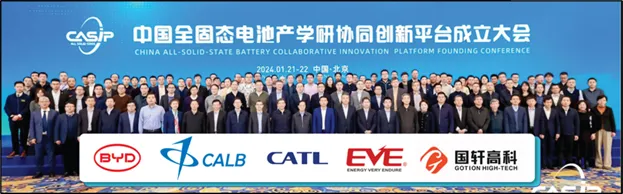
On 21st January 2024, China’s lithium-ion battery, auto companies and government united as part of a government-led drive to commercialise all solid-state batteries by 2030.
The consortium, known as China All-Solid-State Battery Collaborative Innovation Platform (CASIP), will work on basic research, key technologies, and joint development and manufacturing of EVs equipped with solid-state batteries, in addition to setting up a supply chain. CASIP aims to develop and manufacture solid-state batteries that can compete globally, with Chinese companies as the center.
The project will invest around 6 billion CNY (US$830 million) with participants including battery makers CATL, Beijing WeLion New Energy Technology Co., Ltd, and BYD, as well as auto companies FAW, SAIC, and Geely. Battery company members of the consortium include CATL, BYD, CALB, EVE Energy, Gotion and High-Tech, and government members of the consortium include the Ministry of Industry and Information Technology, the Ministry of Science and Technology the State-owned Assets Supervision and Administration Commission of the State Council, and the National Energy Administration. Government-affiliated research institutes, such as the Chinese Academy of Sciences, and influential government-backed funds are also on CASIP’s member list.
China establishes solid-state lithium-ion battery consortium to commercialise the technology
The advantages of ionic conductivity are outstanding, and the leading route is inclined towards sulfides. On April 28, 2024, Wu Kai, chief scientist of CATL, announced in detail for the first time the R&D progress of its all-solid-state batteries at the CIBF2024 Advanced Battery Frontier Technology Seminar, using sulfide solid electrolytes.
Prior to this, the sulfide route was mainly favoured by overseas companies, including Japanese and Korean companies such as Toyota and Samsung, as well as some European and American companies, such as Solid Power and SVOLT, which have successfully manufactured 20 Ah sulfide all-solid-state batteries. Solid Power, Samsung and Nissan have begun to build sulfide all-solid-state battery pilot lines.
At the same time, the sulfide solid electrolyte route has also attracted attention from the academic community. The Sichuan New Energy Vehicle Innovation Center, backed by the team of Academician Ouyang Minggao, is at the forefront of the research and development of all-solid-state batteries and has also taken sulfide all-solid-state batteries as the technical direction of the next generation of batteries.
Many battery manufacturers and automakers have issued announcements indicating that they are participating in the development of solid-state batteries and have set corresponding research and development goals.
At present, the mainstream electrolyte system has different manufacturers in the layout. Judging from the layout progress of various companies, large-scale commercialisation can be achieved in 2028-2030. Most enterprises are currently in the engineering stage from pilot test to mass production.
Commercial Progress Schedule of Solid-state lithium-ion batteries
The development process of new battery products usually goes through several stages such as “Pre-A sample, A sample, B sample, C sample, D sample, and release”. The research and development process is actually a cycle of multiple prototype design-test verification. The entire process needs to fully consider various factors such as chemical system and battery structure, battery performance, production process feasibility and cost, and examine whether the new product meets customer requirements for safety, energy density, power, etc. Battery companies have commonalities in their R&D processes. Taking CATL and solid-state battery manufacturer Solid Power as examples, their battery R&D stage divisions and decision-making considerations are basically the same.
| Stage | Objective | Description | Cell Specification | Adjustment Time |
| Pre-A Sample | Prototype Solution Design | Design cell samples to demonstrate basic functional requirements of the product. | 0.2Ah, 2Ah, 20Ah | Based on R&D progress |
| A Sample | Cell Concept Validation | Prototype cell design and development; evaluate multiple design solutions based on customer needs; supplier testing and selection. | EV Specification | Up to 12 months |
| B Sample | Cell Design Validation | Finalize cell design; test production line samples; ensure cell performance meets customer needs; module and PACK testing validation. | EV Specification | Up to 12–18 months |
| C Sample | Cell Process Validation | Validate manufacturing processes; ensure production yield meets customer requirements; continue PACK testing and prototype integration. | EV Specification | Reserve ~12 months |
| D Sample | Cell Product Validation | Validate the complete cell’s mass production capability; vehicle testing. | EV Specification | Maturity phase |
| Mass Production Sales | Product Sales | Deliver products in bulk to customers. | EV Specification |
New battery products need to reserve a long development time in the early stages of commercial development. When lithium-ion batteries have not reached a complete commercial outbreak, according to Battery China, CATL once said at the 2019 annual performance exchange meeting: “In the international market, it generally takes 36 to 48 months from jointly developing products A, B, and C samples with customers to mass production, and customers generally start to place orders at the second sample stage.” Judging from the solid-state battery product R&D plan disclosed by Solid Power, its reserved R&D cycle from A sample to mass production is at least 48 to 54 months.
To view GDC Solid-State Lithium-ion Battery Market Research Report click here
In terms of product specifications, certain requirements are put forward for battery cell specifications from laboratory to trial production. Taking Solid Power as an example, in the Pre-A sample development stage, the battery cell specifications gradually evolved from a single-layer 0.2Ah mold battery to a 22-layer 20Ah soft-pack battery, and then developed into a 100AhEV specification soft-pack battery before entering the A sample test. CATL’s all-solid-state battery sample that has recently entered trial production is a 20Ah soft-pack battery cell.
Semi-Solid Batteries will come to market first
The semi-solid state has entered the mass production stage, and the all-solid state is in the A sample stage. Summarizing the development of solid-state battery products of major companies, semi-solid-state battery companies such as Qingtao and Beijing WeLion New Energy Technology Co., Ltd have entered the mass production stage, and all-solid-state is mostly in the research and development and sample delivery stage. Factorial Energy, Solid Power and CATL, which have made rapid progress, have entered the A sample stage.
The total planned solid-state battery capacity exceeds 565.7GWh, and the built capacity is about 28.3GWh, which is mainly from Chinese semi-solid-state battery companies.
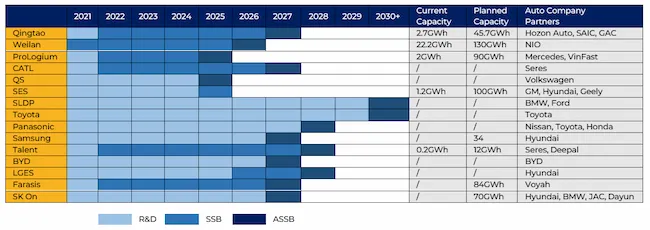
Qingtao + IM Motors, WeLion New Energy + NIO, Ganfeng + Dongfeng Motors, and Ganfeng + Seres have announced installation and mass production. Semi-solid-state batteries have entered the installation and mass production stage first, but judging from the actual sales of vehicle models, the installation progress is lower than expected.
Semi-solid-state batteries have the capacity for mass production, but their advantages in performance and cost need to be further verified. The mass production time announced by all-solid-state battery manufacturers is concentrated in 2027~2028. However, considering the difficulty of breaking through the interface problem of all-solid-state batteries, and the mainstream sulfide route of all-solid-state batteries still has bottlenecks in lithium metal stability and cost, mass production is expected to be delayed until after 2030.
Partnerships are being positioned
Most major players have now established clear production timelines, with initial small-scale manufacturing expected between 2026-2027 and mass production ramping up toward 2030. The technology has advanced on multiple fronts, with energy densities now routinely exceeding 400 Wh/kg (versus <300 Wh/kg for conventional lithium-ion), charging times reduced to under 10 minutes for 80% capacity, and cycle life extending beyond 1,000 cycles with minimal degradation.
Strategic partnerships between battery developers and automotive manufacturers have accelerated, suggesting growing confidence in the technology’s commercial viability.
While challenges remain in scaling production and managing costs, the past 15 months have demonstrated that solid-state batteries are moving steadily from laboratory to commercial reality, with the potential to transform electric vehicles and energy storage within this decade.
Since 2024, solid-state batteries have generally shown an accelerated development trend, and some battery and vehicle companies have successively released relevant progress.
CATL, Narada, EVE Energy, GAC Aion, etc. have successively released relevant technologies and responded to relevant progress in solid-state batteries through investor interaction platforms.
For more blog articles click here
To view GDC market research reports click here
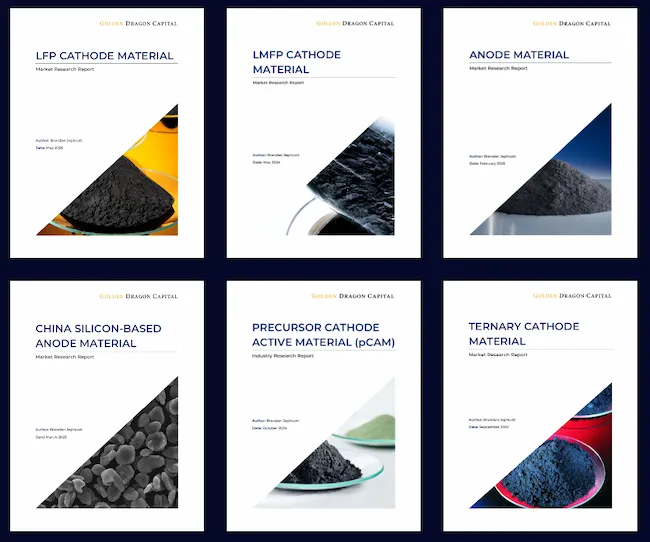
Golden Dragon Capital Limited | Comprehensive Market Research Reports
About us
GDNM provides commentary on how energy transition minerals contribute towards the decarbonisation and electrification of the global economy, with a particular focus on the lithium-ion battery and rare earths supply chains.
GDNM founder, Mr Brendan Jephcott is an Australian who has worked in the global mining sector for more than 13 years, of which his experience covers precious metals, nonferrous metals, ferrous metals, base metals, bulk commodities, rare earths, and the lithium-ion battery industry.
For the last 9 years Mr Jephcott has focused on the burgeoning new energy industry, participating in cross-border transactions in buy-side and sell side roles, cultivating a global business network ranging from upstream resource companies, midstream intermediate product producers, and downstream consumers such as gigafactories and auto companies.