Important pCAM Production Equipment
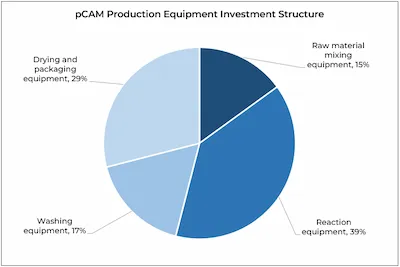
The performance and production cost of ternary cathode material is also related to the selection of three key pieces of pCAM production equipment namely a reactor, filtration and washing equipment, and drying equipment.
pCAM Production Equipment Summary
| Item | Role in pCAM production |
| Reactor | The reactor is the core equipment for the pCAM reaction. Its structural characteristics such as the size of the reactor, the form of the stirrer, the number and size of the baffles, the presence or absence of the guide tube, the feeding position, and the presence or absence of the reinforcement device will all affect the pCAM, density, morphology, specific surface area, degree of crystallization, particle size and distribution and other properties. The pCAM slurry obtained by the reaction is separated from solid and liquid, and then the obtained pCAM filter cake is washed with a washing liquid to remove sulfate radicals, aerial radicals, and aerobic radicals remaining in the filter cake. |
| Filtration and washing equipment | At present, most pCAM manufacturers use integrated filtering and washing equipment, which mainly include filter presses, centrifuges, emblem filters, and “two-in-one” filtering and washing equipment. |
| Drying equipment | In the production of ternary pCAM, the drying operation unit determines the moisture content of the finished pCAM and has a certain impact on the crystal structure. It is an important process. The correct selection of drying equipment is directly related to the quality of the product and the operating environment. and production costs. Commonly used pCAM drying equipment includes hot air circulation ovens, disc dryers, flash dryers, rotary drum dryers, etc. |
pCAM Reactor
The reactor is the core equipment of the pCAM reaction, and its core technology of structural design is in the hands of the pCAM manufacturer. The reactor’s body size, agitator type, number and size of baffles, presence or absence of guide tubes, feed position, presence or absence of reinforcement devices and other structural features all affect the density, morphology, specific surface area, degree of crystallisation, particle size and distribution of the pCAM. The reactor is a customized equipment, generally designed by the pCAM manufacturer, and processed and assembled by the reactor manufacturer according to the drawings.
| Factory A indicators | Factory B indicators | Factory C indicators | |
| Liner Material | 316L stainless steel or glass | 316L stainless steel or titanium | 316L stainless steel |
| Volume | 1~200L | 20~10000L | 5~1000L |
| Stirring Speed | 50~500 r/min | 50~1000 r/min, control degree ±10 r/min | 600~1000 r/min |
| Temperature Range | 30~70°C | 10~90°C, control degree ±0.5°C | – |
| pH Control | 0~14pH, control degree ±0.05pH, dispersion 0.01pH | 2~12pH, control degree ±0.05pH, dispersion 0.01pH | 0~14pH, control degree ±0.02pH, dispersion 0.01pH |
| Control System | PLC control, online can monitor reactor temperature, pressure, and stirring speed | Siemens PLC | – |
pCAM Filtration and Washing Equipment
Filtration and washing equipment separate the solid and liquid of the pCAM slurry obtained by the reaction, and then use washing liquid to wash the pCAM filter cake to remove the sulfate, chloride, sodium ions, etc. remaining in the filter cake. At present, mainstream manufacturers different integrated filtering and washing equipment, including filter presses, centrifuges, microporous filters, filtering and washing “two-in-one” equipment.
| Equipment | Advantages | Disadvantages |
| Filter Press | 1. High production efficiency, single batch processing capacity can reach more than tonnes. 2. Strong adaptability to materials, suitable for large particles and fine-particle pCAM. 3. Simple equipment, good reliability, low failure rate | 1. When the filter plate is pressed, the force on the filter plate is uneven, which may cause deformation and damage to the filter plate. 2. The material in the filter chamber is easily unevenly distributed, and the washing water passes through the position where the filter cake is thin or there is no filter cake, resulting in poor washing effect. |
| Centrifuge | 1. High dehydration efficiency, large particle pCAM filter cake moisture content can reach less than 10%, fine particle pCAM filter cake moisture content can also reach less than 20%. 2. Simple equipment, less consumables, mainly replacement of filter cloth | 1. The failure rate is relatively high, the reliability is poor, and the maintenance workload is large. 2. Centrifuge is prone to severe vibration during the production process which may cause the material in the drum to overflow and even fail to continue to operate. 3. Single batch processing volume is small, generally 200~400kg |
| Microporous Filter | 1. High filtration accuracy, can filter particles above 0.3 microns, high material recovery rate, especially suitable for fine particle pCAM. 2. Powder filter cake washing can be static washing, stirring washing, washing fully. | 1. The dehydration efficiency is average, and the moisture content of the filter cake is high 2. There are many microfilter tubes and rods inside the equipment, which need to be cleaned, regenerated and replaced regularly, and the cost of consumables is high. 3. An air compressor is required, and the gas consumption is large. |
| Filter and Washing “Two-in-One” Equipment | 1. Fully washed, stirring washing can be performed: 2. The equipment is well sealed, no breakpoints, less material loss, low labour intensity during operation, and clean environment | 1. The filter cake is thick, the dehydration efficiency is average, and the moisture content of the pCAM filter cake is high. 2. An air compressor is required, and the gas consumption is large. 3. The equipment has high sealing requirements and is inconvenient to maintain |
pCAM Drying Equipment
The drying operation unit determines the moisture content of the pCAM product and has a certain impact on the crystal structure. Common pCAM drying equipment includes hot air circulation oven, disc dryer, flash dryer, rotary drum dryer, etc.
When selecting a dryer for ternary pCAM, at least the following should be considered: Product moisture content requirements, filter cake moisture content and whether the filter cake moisture content is uniform, dryer production capacity, material feeding method, dryer alkali resistance, and metal impurities or other impurities cannot be substituted, drying temperature to be achieved, drying cost, automatic control level requirements, heat source type, environmental protection regulations, and plant space.
| Equipment | Advantages | Disadvantages |
| Hot Air Circulation Oven | 1. Single batch of materials can be discharged cleanly without residue, suitable for production lines that frequently change product models. 2. Low equipment manufacturing and maintenance costs, low failure rate | 1. Low degree of automation, manual loading and unloading are required, and the labour intensity is high. 2. Dust flies during unloading, material loss is large, and environmental pollution is serious. 3. Low drying efficiency and long-time; 4. High energy consumption, temperature rise and fall are required every time |
| Disc Dryer | 1. Continuous feeding and discharging can be achieved, with high thermal efficiency, low energy consumption and short drying time. 2. High level of automation and low labour intensity of workers. 3. Small footprint | 1. The he rake leaves and the drying plate are prone to friction, resulting in an increase in metal impurities in the product; 2. The materials inside the equipment are not easy to clean, and it is not suitable for production lines that frequently change product models; 3. Equipment maintenance is difficult and the cycle is long |
| Flash Dryer | 1. The material has good dispersion during the deep drying process and is not easy to agglomerate. It is suitable for drying pCAM filter cakes with small particle size and high moisture content. 2. High level of automation, continuous feeding, short drying time and low labour intensity of workers | 1. The material needs to be driven by hot air, and a large amount of heat is discharged during the drying process, resulting in high energy consumption. 2. Because the material moves at high speed in the dryer, the equipment is severely damaged, reducing the life of the equipment. 3. The equipment has a complex structure and a large investment |
| Rotary Drum Dryer | 1. Continuous feeding and discharging can be achieved, with high thermal efficiency, low energy consumption and short drying time. 2. There are no friction parts inside the equipment, and metal impurities will not be introduced during the drying process. 3. High level of automation and low labour intensity of workers | 1. The equipment is long and occupies a large area; 2. The material is easy to stick to the wall during the drying process, which is not easy to clean. After long-term use, the drying efficiency will be reduced. 3. The equipment is large, and once a failure occurs, the maintenance period is long |
For more blog articles click here
To view GDC market research reports click here
About us
GDNM provides commentary on how energy transition minerals contribute towards the decarbonisation and electrification of the global economy, with a particular focus on the lithium-ion battery and rare earths supply chains.
GDNM founder, Mr Brendan Jephcott is an Australian who has worked in the global mining sector for more than 13 years, of which his experience covers precious metals, nonferrous metals, ferrous metals, base metals, bulk commodities, rare earths, and the lithium-ion battery industry.
For the last 9 years Mr Jephcott has focused on the burgeoning new energy industry, participating in cross-border transactions in buy-side and sell side roles, cultivating a global business network ranging from upstream resource companies, midstream intermediate product producers, and downstream consumers such as gigafactories and auto companies.